
• Skip to primary navigation
  • Skip to main content
  • About Us
    • Board of Directors
    • National Advisors
    • Staff
  • Partners
    • Testimonials
  • Resilience Assessments
  • Initiatives
    • Current Initiatives
      • Expert’s Panel Webinar Addresses Risks Posed by Seriously Outdated Emergency Power Systems    
      • Power P.I.O.N.E.E.R.
      • Power Outage Partners
      • Patient P.I.O.N.E.E.R.
    • Past Initiatives
      • Power Resilience Blueprint for America
      • DHS Security & Resilience Challenge
      • Los Angeles County EMS Agency Initiative
  • Resources
    • ASSESS EMERGENCY POWER VULNERABILITIES
    • Reference Materials & Assessment Tools
  • News
  • Contact Us
Home » News

News

Los Angeles County EMS Agency Introduces Groundbreaking New Protocols Recommended by Powered for Patients to Safeguard Emergency Power

09.28.23

The Los Angeles County Emergency Medical Services (EMS) Agency has introduced groundbreaking new protocols to safeguard emergency power in hospitals following a Powered for Patients-led initiative that identified a number of vulnerabilities and recommended new measures to better protect patients during power outages.

The new protocols were introduced in the recently published Healthcare Facility Emergency Power Resilience Playbook, which is the culmination of the comprehensive emergency power resilience initiative launched by the EMS Agency in May 2019. The initiative was driven in part by the increasing use of Public Safety Power Shutoffs (PSPS) by Southern California Edison to reduce the risk of wildfires sparked by utility lines. Powered for Patients (P4P) was hired as the contractor to support the initiative.  P4P founder and project director Eric Cote led the initiative and authored the recently published Playbook which has been distributed to all hospitals in LA County and sub-acute skilled nursing facilities.

During the initial phases of the initiative, Cote evaluated state and county emergency response plans to assess how they addressed threats to emergency power during a power outage. He also conducted a preliminary assessment of emergency power systems among a representative sample of LA County hospitals and created an inventory of temporary emergency power assets owned by LA County agencies and the cities of Long Beach and Los Angeles that could be deployed to hospitals during an emergency.

Cote concluded his initial work with a series of recommendations to address the vulnerabilities he uncovered, including the absence of any protocol addressing emergency power threat reporting and response. To address this gap, Cote recommended creation of an emergency power threat reporting protocol to provide county officials with an early warning at the first sign of a serious threat to emergency power during an outage. This improved situational awareness would accelerate government and private sector response to a stricken facility.

After touring emergency power systems at eight hospitals in LA County, Cote got his first glimpse of the vulnerabilities of some emergency power systems, leading to his recommendation that a census of every hospital’s emergency power system be conducted during a later phase of the project. Cote also proposed creation of a first-of-its-kind confidential risk rating of hospital emergency power systems to help county officials maintain higher vigilance of hospitals with risk factors such as outdated generators, limited onsite fuel storage or lack of redundant emergency power. Paying closer attention to the emergency power status of these higher risk facilities during an outage would give county officials a head start in addressing any threats to emergency power before they might trigger an emergency evacuation.

Cote’s census of emergency power systems in 80 LA county hospitals captured data on 271 generators and confirmed his concerns about an aging generator fleet. More than 30% of the generators captured in the census were over 30 years of age, considered the useful life of a generator based on a 2017 white paper published by Powered for Patients and the American Society of Healthcare Engineering. Among the county’s 14 single generator hospitals, the problem of outdated generators was twice as bad, with 64% of these facilities relying on generators in excess of 30 years of age, with some generators older than 40, 50 and even 60 years of age, a finding that raised serious concerns with EMS Agency leaders and public health officials in Sacramento.

“The discovery of so many outdated generators helped make the case for taking the unprecedented step of creating a confidential, risk rating of hospital emergency power systems,” said Cote.  EMS Agency officials adopted a two-tier risk system, with higher risk facilities designated as Tier 2 facilities.  EMS Agency officials staffing the agency’s 24/7, 365 Medical Alert Center, which will monitor emergency power status in LA County hospitals, will have restricted access to the list of Tier 2 hospitals so they know which ones to watch more closely during an outage.    

The recently published Playbook introduces the risk tiers and a robust emergency power status reporting protocol that requires hospitals to report emergency power status through ReddiNet within 30 minutes of a power outage. ReddiNet is the online platform developed by the Hospital Association of Southern California (HASC) that is used by the LA County EMS Agency, and 21 other California counties, for two-way communications between county EMS officials and hospitals. ReddiNet enables EMS agencies to poll hospitals on their status and allows hospitals to post information about limitations they may face in accepting new patients or providing advanced life-saving services. ReddiNet developed a new emergency power status reporting dashboard to accommodate the new LA County EMS Agency protocol.

Over the past two months, training sessions and table-top exercises have been conducted for hospitals in Los Angeles County to introduce the Playbook and its new protocols.
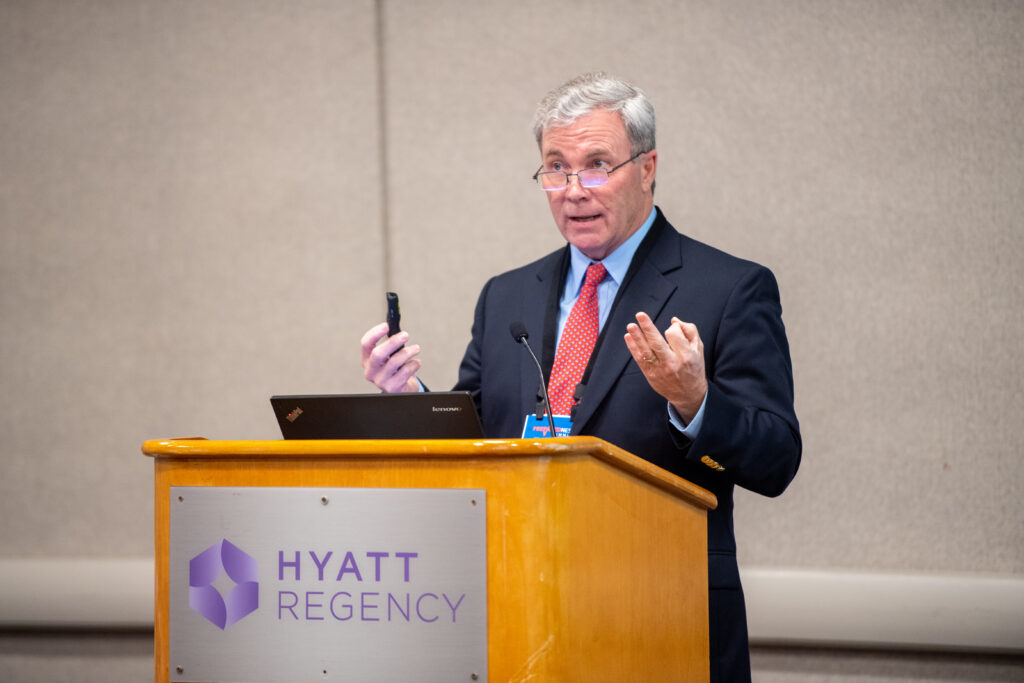
P4P Project Director Serves as Panelist at National Governor’s Association Summit on Emergency Power Resilience

08.23.23

The National Governors Association Center for Best Practices invited Powered for Patients project director Eric Cote to serve as a panelist for a discussion on the intersections of supporting emergency preparedness for healthcare facilities and bolstering the healthcare workforce at an August 2023 Healthcare Workforce Summit held in Bloomfield, CO.

Cote addressed the connection between workforce challenges in the hospital sector and emergency power resilience, noting that retirements among hospital facility directors are outpacing the ability of hospitals to fill vacancies. Cote said the shortage of facility directors, and other members of hospital engineering departments, can have a direct impact on emergency power readiness. Among the solutions Cote offered to address staff shortages was leveraging available technology to remotely monitor emergency power systems and provide automated, real time notifications when emergency power systems are activated or experience a problem while operating.

P4P Project Director Introduces First-of-its-Kind Power Outage Partners Initiative at the 2023 Public Health Preparedness Summit Presentation

04.24.23

Eric Cote speaks at the 2023 Public Health Preparedness Summit in Atlanta, GA where he and his colleagues from the Association of State and Territorial Health Officials (ASTHO) introduced the groundbreaking Power Outage Partners initiative, launched with the Louisiana Department of Health with CDC funding and technical support from ASTHO. 

Powered for Patients project director Eric Cote joined clients from the Association of State and Territorial Health Officials (ASTHO) at the 2023 Public Health Preparedness Summit in Atlanta recently to introduce an ASTHO Toolkit that will help jurisdictions launch initiatives to boost power outage support for in-home life support users.

The Toolkit chronicles Power Outage Partners, an initiative launched in 2021 with the Louisiana Department of Health (LDH) to provide in-home life support users with additional batteries to extend device runtime during power outages. The project received funding and technical assistance from the CDC and ASTHO. P4P project director Eric Cote developed the initial concept for the initiative and was hired by ASTHO to serve as the project consultant, a role that involved working with LDH officials to develop and launch an operational plan for the initiative. Cote also authored ASTHO’s recently published Toolkit.

“Helping to develop Power Outage Partners from a concept to a groundbreaking new program that provides unprecedented support to life support users has been extremely rewarding,” said Cote. “I’m grateful to ASTHO and the Louisiana Department of Health for seeing the promise of Power Outage Partners in fundamentally changing the way jurisdictions can support their most at-risk citizens during power outages.”

Cote also thanked the DME suppliers working with him to sustain Power Outage Partners after the initial funding from the CDC and ASTHO was exhausted. Access Respiratory, a Quipt Home Medical company, Breathing Care, and VieMed, three leading DME suppliers in Louisiana, have partnered with Cote to support the initiative. The three companies will dedicate a portion of their revenue from the sale of batteries to invasively ventilated Louisianans to support the program in Louisiana and help spur its expansion to other states.

As of November 2023, Cote was working with LDH officials on final preparations for a program launch in January 2024.  Cote is also working with other jurisdictions interested in following Louisiana’s lead.

Putting a Stop to Backup Power Generator Failures  

03.04.22

Strategic Perspectives: Critical Infrastructure Journal

03.04.22

How old is too old? Assessing emergency power risks of aging generators. MC&D Magazine

03.04.22

Los Angeles County EMS Agency Tackles Aging Hospital Generator Fleet with Deployment of Advanced, Real-Time Generator Monitoring Technology

10.07.21

Deployment of Power P.I.O.N.E.E.R. Tool to County’s Single Generator Hospitals Will Provide Unprecedented Situational Awareness of Generator Failures During Power Outages

The Los Angeles County Emergency Medical Services (EMS) Agency is tackling the county’s challenge of an aging hospital generator fleet by deploying an advanced technology that will provide automated, real-time alerts anytime a hospital generator experiences a mechanical problem during a power outage.

Recently, the Power P.I.O.N.E.E.R.® tool was installed at two of Los Angeles County’s single-generator, acute care hospitals. P.I.O.N.E.E.R.®, which stands for Power Information Needed to Expedite Emergency Response, continuously monitors generator performance and sends automated, real-time warnings to designated individuals anytime a generator experiences a mechanical problem during a power outage.  

The deployments represent the first time a U.S. hospital is making automated, real-time generator threat alerts available to government emergency managers. These real-time alerts are a major improvement in situational awareness and will enable accelerated deployment of government generators and provide a valuable head start in planning for a potential hospital evacuation. The early warnings will also give utilities the opportunity to quickly assess options for prioritized power restoration including switching feeder lines to a hospital in cases where two lines exist and one of them is still able to provide power to the hospital. 

Deployment of Power P.I.O.N.E.E.R. to single generator hospitals was considered especially important since these facilities have no redundant emergency power, and as a result, put patients at greater risk if the facilities experience a total loss of emergency power. The LA County EMS Agency is tapping its HHS Hospital Preparedness Program (HPP) funding to cover the cost of deploying the Power P.I.O.N.E.E.R. tool in the county’s single generator hospitals.

Power P.I.O.N.E.E.R.® was developed by the 501c3 non-profit Powered for Patients as part of a Department of Homeland Security-funded initiative to spur advances in generator monitoring technology that would provide an early warning to government officials and utilities when critical facilities face a threat to emergency power during an outage. Power P.I.O.N.E.E.R. is also designed to provide ongoing, real-time updates on the status of efforts by government officials, utilities and service providers to respond to a stricken facility.  Powered for Patients has been leading an emergency power preparedness initiative for the LA County EMS Agency since May 2019. The multi-year initiative was launched to help ensure that Los Angeles County and its municipalities, along with its electric utilities and critical healthcare facilities, are employing best practices in minimizing threats to emergency power and expediting government, utility and private sector response when threats to emergency power arise during power outages.

“Given the ongoing threat of Public Safety Power Shutoffs, and the potential for other types of power outages in Los Angeles County, we’re excited to see Power P.I.O.N.E.E.R. providing real time situational awareness of generator threats at the county’s single generator hospitals,” said Eric Cote, Project Director for Powered for Patients. “This visibility is especially important since single-generator hospitals have no redundant emergency power and in some cases are relying on older generators. As more of LA County’s single-generator hospitals deploy Power P.I.O.N.E.E.R., the impact of this powerful new tool in protecting patients will become even greater.”  

Concern about outdated hospital generators in Los Angeles County is driven by a recently completed analysis documenting a seriously aging fleet. The analysis of the generator fleet in Los Angeles County’s hospitals is part of the LA County EMS Agency’s ongoing emergency power preparedness initiative being led by Powered for Patients.  The analysis reflects survey data from the county’s 80 hospitals that participate in the Hospital Preparedness Program which have a combined total of 271 generators. The useful life expectancy of a generator is approximately 30 years of age and the recent analysis showed that 87 out of the 271 generators, or 32 percent, are older than 30 years of age, with 40 of these generators between 40 and 49 years of age and 15 of the generators older than 50 years of age.

Among LA county’s 14 single-generator acute care hospitals that participate in the Hospital Preparedness Program, nine of these facilities, or 64 percent, have generators over 30 years of age, including three with generators between 40 and 49 years of age, three with generators between 50 and 59 years of age and one with a generator that is over 60 years old.  There are no federal or state requirements that limit the age of a hospital generator as long as the generator can pass periodic tests. However, Cote noted that these tests don’t represent the true challenge an aging generator would face if it were required to operate continuously for extended periods of time.  

Despite the aging fleet, the analysis showed some positive signs when it comes to investment by hospitals in new generators. Over the past ten years, Los Angeles County hospitals have collectively purchased 48 new generators.

  • « Go to Previous Page
  • Page 1
  • Page 2

5600 Post Road, East Greenwich, RI 02818 | 401-374-8500

  • About Us
  • Partners
  • Resilience Assessments
  • Initiatives
  • Resources
  • News
  • Contact

©Copyright 2023 Powered for Patients